



I shipped 4 iOS apps this year. Oakling, Carvd, FurPass, NFCtree. I have a portfolio site, a resume in two formats(HTML and pdf), and a LinkedIn profile I have been updating since 2015.
A recruiter still could not find me.
I found out by Googling my own name and reading page one like a stranger.
An old title. A resume from two roles ago, still ranking.
A portfolio Google had never crawled.
So I ran it as a research project.
Same process I would run on a client’s product. Audit the surfaces. Read the structure. Check what the signals say against what I meant them to say. Find where it breaks.
The only difference is that the product was me.
I posted what I fixed as I went. One of those posts reached 102,230 people, which told me I am not the only one with this problem.
It broke in four places.
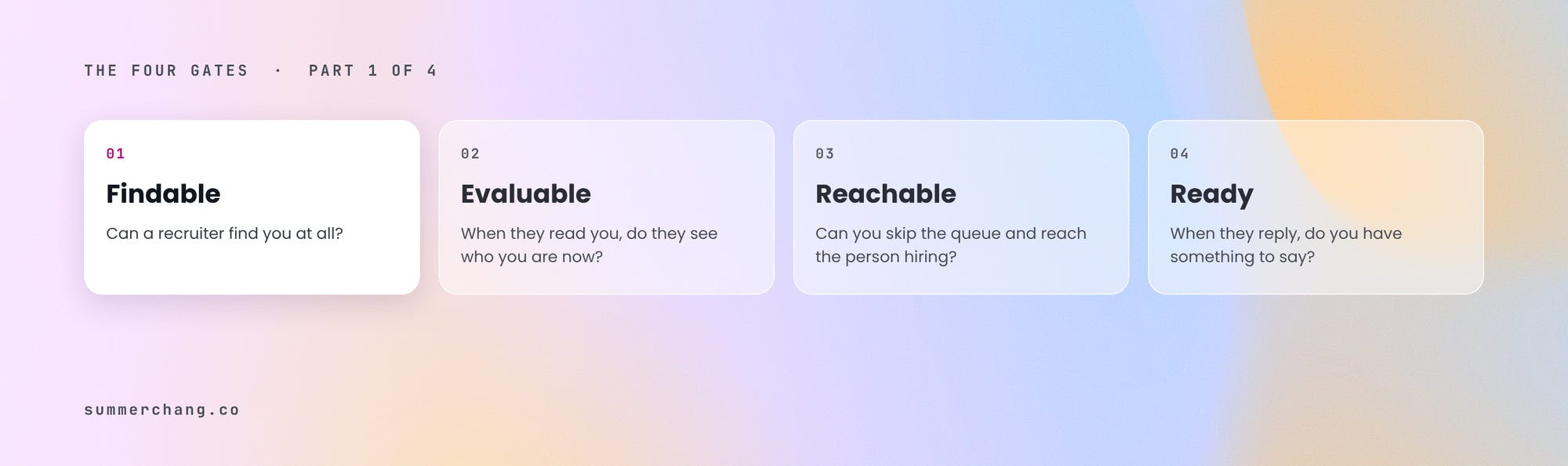
Four gates. Each one stops you cold if the one before it is not fixed.
Findable. Can a recruiter find you at all?
Evaluable. When they read you, do they see who you are now?
Reachable. Can you skip the queue and reach the person hiring?
Ready. When they reply, do you have something to say?
This issue is gate one.
If recruiters already message you every week, gate one is not your problem. Skip to Part 3.
The path a recruiter takes
They see your LinkedIn first.
They Google you next.
They open your portfolio.
Then they download your resume.
Four surfaces, four chances to tell a different story. I was telling four different stories.
Fix the site so Google can read it
Most designers skip this because it does not feel like design work. It took me an afternoon.
Pick one URL. “www” or the bare domain, not both. Two versions of the same site split your ranking between them.
Write a page title and description for every page. The title is what shows in the Google result. Write it for a person.
Add Open Graph tags. These make your link show a card in a LinkedIn message instead of plain text. If your portfolio link looks broken when you paste it, this is why.
Check your sitemap. Most site builders make one at /sitemap.xml. Open it and confirm your pages are listed.
Submit it in Google Search Console. Then request indexing on your top pages. Then wait. This is not instant.
Check robots.txt. Staging sites often ship with a line that tells Google to stay out, and nobody remembers to remove it.
Publishing is not the finish line. The page still has to be found, read, and understood.
Fix the profile so search can match it
Recruiter search reads your headline, job titles, location, and skills. It does not read your About section closely. A well-written About that nobody searches for does very little.
So I stopped writing clever titles. My Experience entries now say “Senior Product Designer,” because that is what a recruiter types.
I cut my skills list down to what I want to be known for now, not everything I have ever touched. A long list of skills is a list of nothing.
Make the four surfaces agree
Findable gets you seen. Consistent makes you make sense.
LinkedIn — title, headline, location, skills
Portfolio — title, positioning, one URL
Resume, both formats — same role, same dates, same experience
Google result — page title and description
Old profiles on Behance, Dribbble, or job boards count too. Update them, redirect them, or delete them.
The five-minute test
This is the one thing to do this week.
Search your name.
Your name plus product designer.
Your name plus resume.
Read page one like a stranger.
What title shows up?
Which profile ranks first?
Is an old resume still winning?
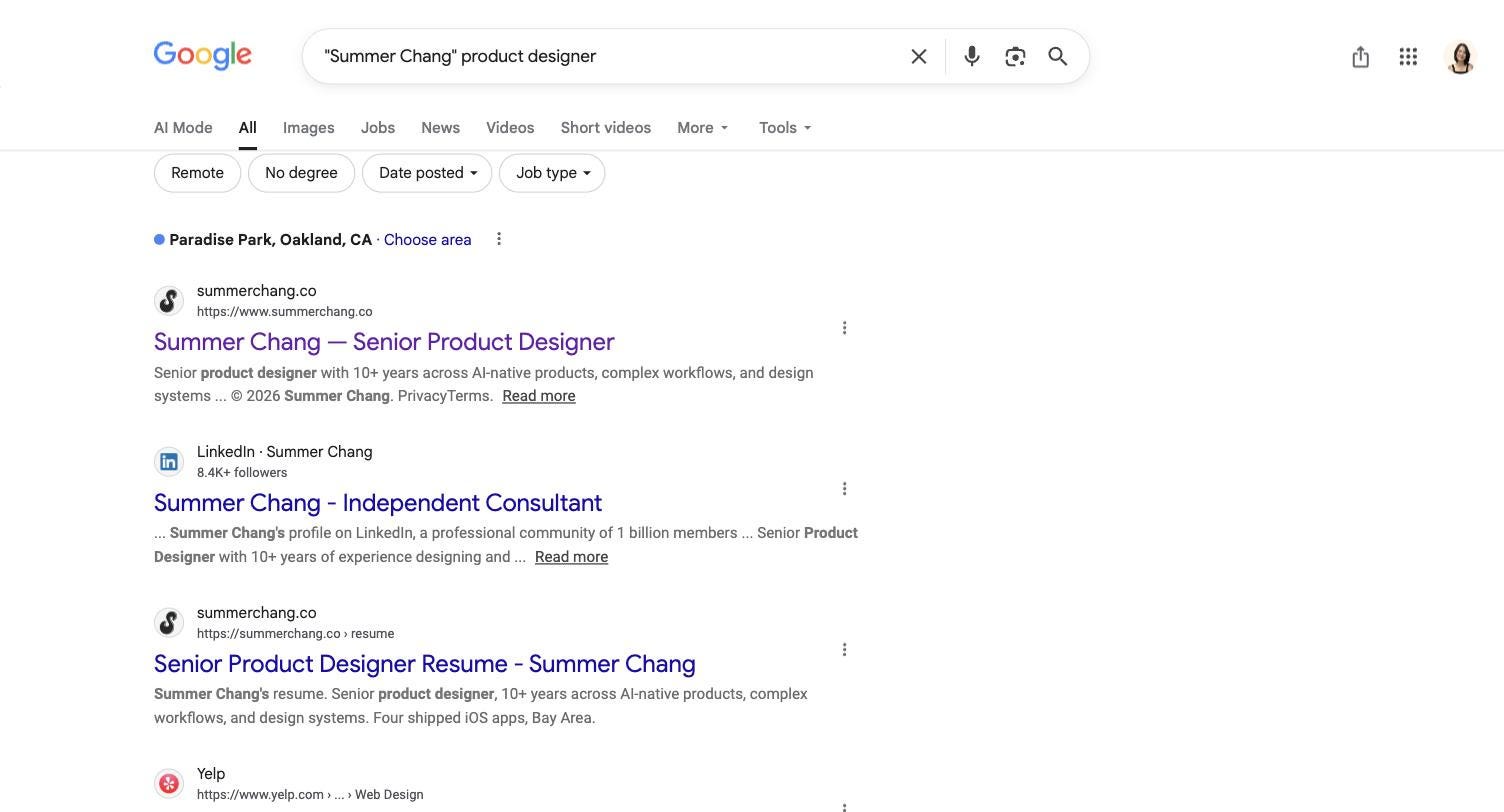
My page one, live.
Do not fix anything yet. Just write down which surface is lying about you.
What still is not working
Four weeks in, my portfolio ranks first and third. Good.
My LinkedIn result on the same page still shows a title I retired.
That is the honest state of it. Search results do not update on your schedule, and one of my four surfaces is still telling the old story while I write this.
What I could not answer
Two things.
First, whether any of this brings recruiters to me, or whether it only helps once someone already has my name. I can back the second one. Not the first. Ask me in three months.
Second, and this is the one that set up next week.
I could see that my four surfaces disagreed with each other. I could not see what they added up to.
If a stranger read all four in ninety seconds, what would they conclude about me?
I am too close to it. I know what I meant. So I stopped guessing and got someone else to read it.
Your turn
Run the three searches. Which of your surfaces is lying about you?
Reply and tell me the worst one. I read every reply.
Next Friday, Part 2: I Audited Myself Like a Recruiter. That is the question above, answered. I exported my own LinkedIn profile, handed it to a model, and asked it to reject me. What came back was not the story I thought I was telling.
Tools
Google Search Console for the sitemap, indexing, and the searches that actually surface you