



Nothing on my LinkedIn profile was false.
The signals still added up to a conclusion I never chose.
That is the part I did not see coming, and I only saw it because I stopped reading my own profile and got someone else to read it for me.
Last week I got found. This week is the question I ended on: if a stranger reads all my surfaces in ninety seconds, what do they conclude?
Here is how I found out.
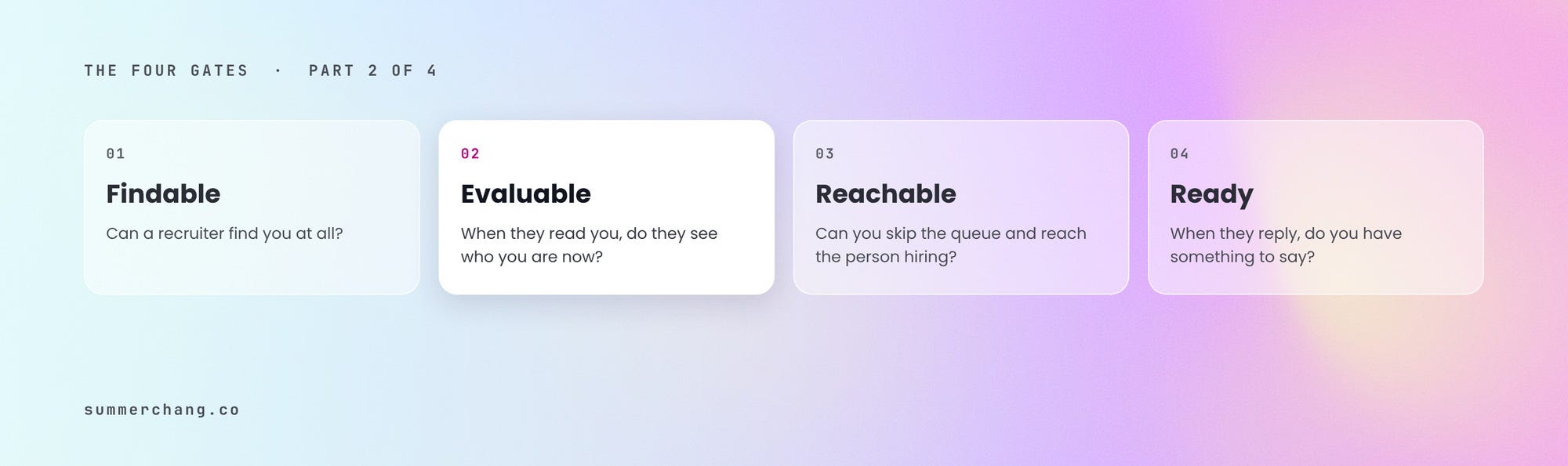
Reading your own profile does not work. You know what you meant. A recruiter only has what is on the page.
So I took myself out of it.
Export it, then hand it over
Takes about fifteen minutes, most of which is waiting for an email.
LinkedIn Settings, then Data privacy, then Get a copy of your data.
Request Profile and Positions. Skip the full archive. Those two files are the ones that matter.
Wait for the email. The small export usually arrives in a few minutes.
Open the files and read them yourself first. Stripped of your photo and the layout, they are surprisingly bleak.
Paste them into a model with a role instruction, not a request for help.
That last step is the whole trick.
The prompt that worked
I was not asking for edits. I was asking for a reading. The rejection framing mattered more than the exact wording. These are the questions I kept:
“You are a technical recruiter filling a Senior Product Designer role at an AI company. Read this profile. What would make you skip this candidate in a stack of forty?”
“Do the skills back up the headline? Where is the gap?”
“Does every section tell the same story? Where does it contradict itself?”
“What is this profile accidentally saying that the person probably did not intend?”
The last question was the most useful because it forced the model to read the profile as evidence, not as something it was supposed to improve.
The conclusion I never chose
For years my profile leaned into being self-employed and building my own products. All true.
Here is what it also quietly said.
She is a founder.
She wants to stay independent.
She may not be ready to commit to a team.
That is not the story I want to tell now. I am ready to focus on product full-time, work alongside a team, and stay with the decisions long enough to see what happens after launch.
Every fact was accurate. The conclusion was not mine.
The five changes I made
Role. “Senior Product Designer” now says the same thing in my headline, my About, and every Experience entry.
Skills. Cut to what I want to be known for now, not everything I have ever touched.
Focus. Pulled back the freelance and marketing signals. Kept product, UX, interaction, and systems.
Team. Cut the language that made me sound like I only work alone. Added how I work with founders, engineers, and product teams.
Experience. This was the biggest one, and it needs its own section.
One wall became four doors
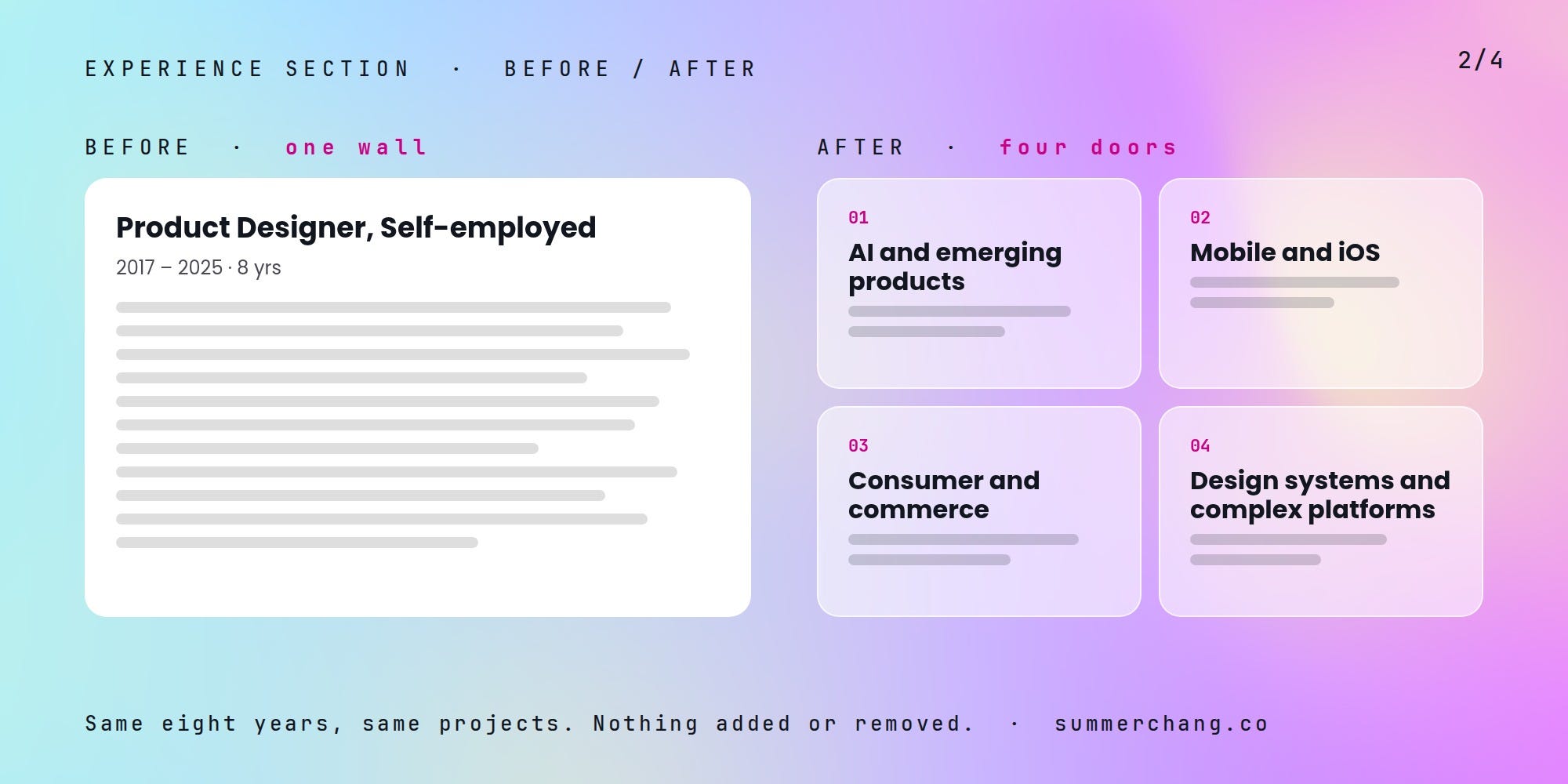
My Experience used to be one self-employed block covering eight years.
Nobody can read that. It is a wall.
So I regrouped the same work by the problems I have actually solved:
AI and emerging products
Mobile and iOS
Consumer and commerce
Design systems and complex platforms
Four groups. Same eight years, same projects, nothing added or removed.
Now a reader can jump to the one they care about. A hiring manager looking for mobile work finds it in a second instead of reading eight years to see if it is in there.
Where the model was wrong
It will flatter you if you let it. Ask it to help and it will tell you your profile is strong. Ask it to reject you and it gets useful.
It also pushed keywords too hard. It wanted “AI-native” in every line, which reads as trying too hard. I ignored that.
And it kept suggesting numbers I do not have. I did not take those. A number you cannot defend falls apart in the first interview, and an honest profile is worth more than a keyword match.
Treat it as a second opinion from someone who has never met you. Useful for exactly that reason, and wrong about everything it cannot see.
A profile is not a record of what you have done. It is a signal of what you are ready to do next.
Do this one thing
Export your profile and paste it into whatever model you already use. Ask one question:
“What would make you skip this candidate in a stack of forty?”
You do not have to act on the answer today. You just have to see it.
What I could not answer
The profile now says what I meant it to say. I still cannot prove that changed what any recruiter does. I can only prove it changed what the page says.
And there is a bigger hole underneath that one.
A profile only works if the right person opens it. I had no way to know whether that was happening.
So the next question was not about the profile at all. It was about how I get in front of people, and whether the thing I was paying for every month was doing any of that work.
Your turn
Reply and tell me what it said about you. I will tell you what mine said back.
Next Friday, Part 3: I Cancelled LinkedIn Premium. That is the question above, answered. Two months in I stopped paying for it, and what I replaced it with worked better than the subscription did.
Tools
LinkedIn data export, under Settings, Data privacy, Get a copy of your data
Claude for the recruiter reading and the rewrite pass
I’m Summer Chang, a Senior Product Designer in Berkeley, California. This series is a research project: the same process I would run on a client’s product, pointed at my own career surfaces. Portfolio: summerchang.co