



Five things interviewers asked for. A portfolio was one.
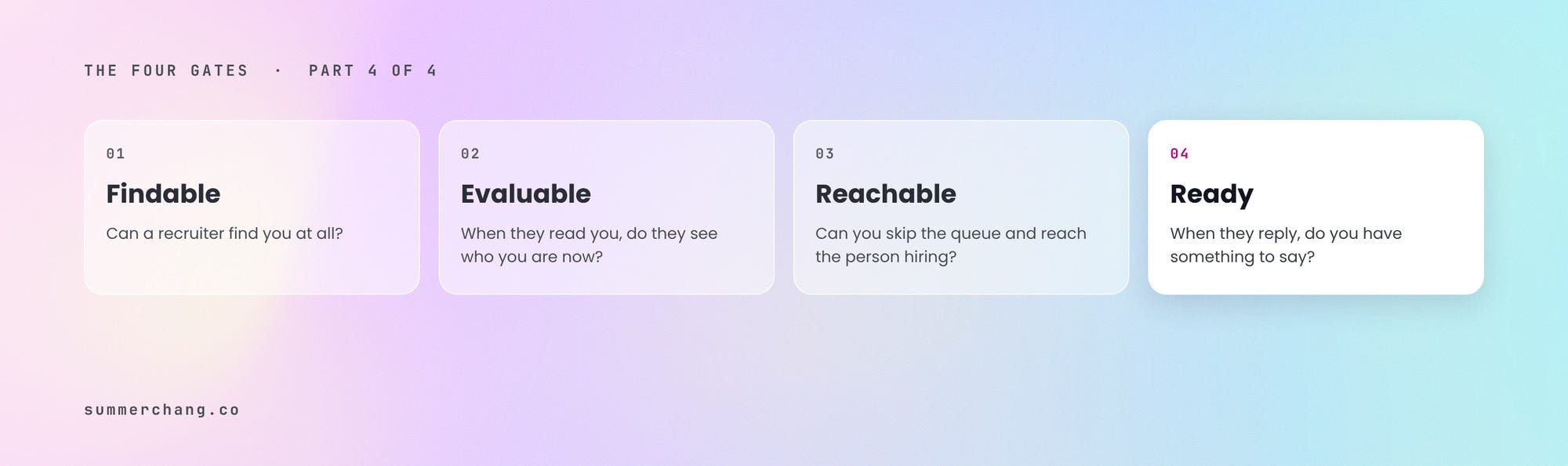
Gate one got me found. Gate two got me read right. Gate three got me replies.
Then the first call came, and someone said, “Walk me through a project.”
I had a portfolio. My story was still not clear.
Last week ended on that gap. A reply is an opening, and an opening only helps if you can answer the first question about your work without stalling.
What they actually asked for
Two weeks of interviews, from startup founders to hiring managers at a large company. Five things came up. The portfolio was only one of them.
Portfolio site. The hook. What gets their attention.
AI fluency. Not the word. How you actually work.
A deck. The longer story. How you led each project.
GitHub. What you shipped and put in front of people.
Figma, opened live. The messy version.
None of these is a pretty screen. Each one is a different way of asking the same thing: can you explain how you think, decide, and ship when the brief is unclear?
More material did not fix it
My first fix was to collect. I built a question bank in Notion. A hundred questions, sixteen categories, tagged by interview type.
It showed me where the gaps were. The AI category grew fastest, and it is where most portfolios go quiet:
How do you decide what the AI does on its own versus what stays with the person?
When is a chatbot the wrong answer?
Is hallucination a bug to hide, or a property to design around?
How do you set expectations so people do not over-trust the output?
The bank told me what I would be asked. It did not make my story any clearer. I still had projects, not answers.
One project, four answers
The problem was not how much I had. It was that I did not know which question each project answered.
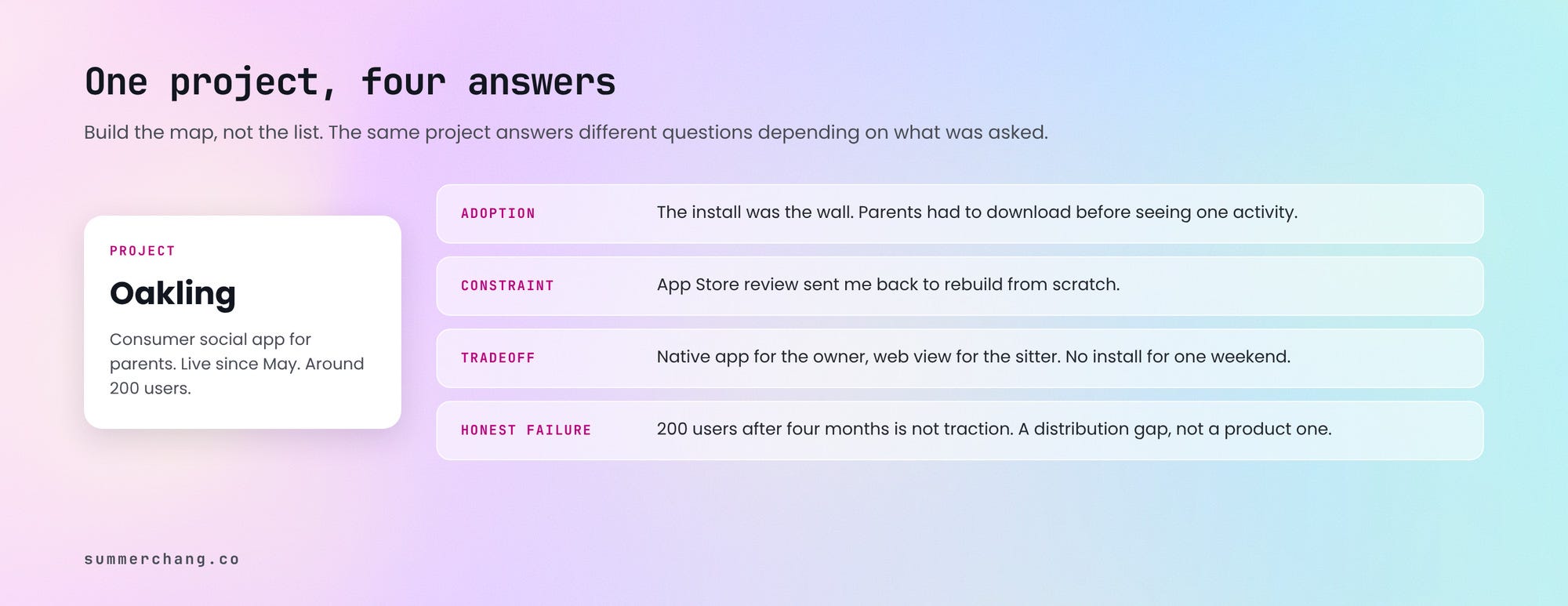
Oakling is not “the family activities app.” It is four answers.
Adoption. The install was the wall. Parents had to download before they could see a single activity.
Constraint. The original web app had reliability problems: broken links, delayed sharing, stale data. For a product built around real-world meetups, trust mattered more than staying in the browser.
Tradeoff. Going native fixed reliability and freshness. It also made acquisition harder, because the install now came before the value.
Honest failure. About 200 users after four months is not traction. The product taught me reliability and trust. Distribution is still unsolved.
Same project. Four answers, depending on what they ask.
What do you lead with when the project was small and the win was the process, not the number?
Four apps taught me the constraints that show up at the end.
Permissions, privacy, payments, empty states, review.
I learned to ship, not ship to earn. It’s something I’m working on.
Four weeks, four articles. That is the research written up.
Some of it will turn out to be wrong. When it does, you will hear about that too.
There is a bonus article next Friday. “It is about the person in the process nobody treats as part of the network.”
The one piece of feedback that actually changed something came from a recruiter.
A recruiter found me on LinkedIn and told me my resume did not look good on paper. Two phone calls later, I had a different resume.
The true is… Recruiters do not owe you feedback. An agency recruiter gets paid when you get hired. An in-house recruiter is judged on who they put in front of the hiring manager. Sending someone through who is not ready costs them.
So the honest feedback only shows up when your fit and their stake line up.